


The Invisible Crisis of the Rohingya Mind

Updated: 3 days ago
An Anatomy of Life Under Prolonged Statelessness: Understanding Rohingya Experiences
This visual investigation explores the psychological landscape of Rohingya life in Cox's Bazar, Bangladesh. Drawing on documentary photography, community interviews, field observations, desk research, and a community-led wellbeing survey involving 247 respondents, it examines how displacement, statelessness, restricted movement, and prolonged uncertainty shape everyday experiences. Rather than focusing solely on past violence, the project traces the emotional, social, and physical consequences of a future that remains suspended.
Produced by Rohingyatographer with support from the Global Statelessness Fund
Lead Contributors
David Palazón, Ayub Khan, Ahtaram Shin, Maung Emdadul Hasan, and Ishrat Bibi
Community Wellbeing Survey
Maung Emdadul Hasan
Women's Interviews and Testimonies
Ishrat Bibi (coordination), Suhima, Thida Hlaing, Moe Moe Lwin, Khaleda Siddique, Dilara, Zainab Lily, Sujut Ara, Somiha, Kaleda Lobi, Shohida Abul, Umme Kulsum, and Naqi Yah
Illustration
Nawab Sharif and Zainab Lily
Photography and Visual Documentation
Ayub Khan, David Palazón, Reyes Islam, Ro Yassin Abdumonab, Sahat Zia Hero, Sadek Husein, Mohammed Ederis, Ajida, Maung Emdadul Hasan, Md Asom, Ro Harez Khan, Ro Aros Kamal, Fayazul Islam, TG Azim, Ro Anis Hla Myint, Anayat Rahaman, Nawab Sharif, Ro Arfat Khan, Sabekur Nahar, and Lokman Hakim
A Mind in Exile
More than one million Rohingya refugees live across a sprawling network of settlements in the hills surrounding Cox’s Bazar in southeastern Bangladesh. From a distance, the camps appear almost permanent: endless rows of bamboo shelters, footpaths cutting through steep slopes, mosques, learning centres, markets, and drainage channels stretching across the landscape. Yet permanence is precisely what remains absent from daily life.
For nearly a decade, the Rohingya have existed in a state of prolonged uncertainty. They cannot return safely to Myanmar. They cannot settle permanently in Bangladesh. They cannot move freely, pursue higher education on equal terms, or participate fully in public life. Their lives are organised around waiting: for decisions, opportunities, recognition, and a future that never seems to arrive.

Much has been written about the violence that forced the Rohingya from Myanmar. Journalists, researchers, aid agencies, and human rights organisations have documented mass displacement, military attacks, village burnings, killings, and systematic persecution. Far less attention has been given to what happens afterwards. What does it mean to live for years in a condition that remains officially temporary but increasingly feels permanent? How do people make sense of uncertainty when it becomes the organising principle of everyday life?
This investigation began with a simple question: how do Rohingya people describe mental health? The question emerged from conversations inside the camps, where people often described emotional wellbeing in terms that differed from the language commonly used in humanitarian and clinical settings. Yet when Rohingya people describe their own experiences, they frequently draw upon a different vocabulary, one rooted in language, memory, religion, family, and community life.
To explore these questions, Rohingyatographer conducted a community-led survey involving 247 Rohingya respondents across multiple camps. Participants were asked about emotional wellbeing, sources of distress, coping mechanisms, aspirations, fears, and everyday experiences. Alongside the survey, contributors documented personal testimonies, photographs, drawings, and observations collected over several years of work inside the camps.
The findings reveal a picture that is both familiar and surprising. Familiar because memories of violence remain deeply present. Many respondents had witnessed killings, military attacks, village burnings, or forced displacement. Certain sounds, smells, and events continue to trigger powerful memories. Fire, in particular, occupies a unique place in the collective imagination, connecting present-day camp disasters with the destruction of villages left behind in Myanmar.
Yet the survey also revealed something else. When people spoke about emotional distress, they often spoke less about the past than about the present. They spoke about education, work, movement, documents, citizenship, family separation, and uncertainty. They spoke about restrictions. They spoke about dependence. They spoke about being unable to imagine what comes next.
One participant explained: "My stress and anxiety includes a few things which affect my mental health. First, I always think of my future and do not see anything good. Due to not having any citizenship or documents. This prevents us from many opportunities."
Another reflected on what had been lost: "I face emotional difficulties as I miss my home in Myanmar. I can still visualise my life and home back in Myanmar."
Taken together, these responses reveal something important. The dominant concerns are not limited to memories of violence. They are also about interrupted lives. The inability to study. The inability to work. The inability to move freely. The inability to plan. The inability to progress.
This distinction matters. The dominant public narrative surrounding the Rohingya often frames psychological suffering as a consequence of past trauma. Trauma is undoubtedly part of the story. But it is not the whole story. The survey suggests that emotional wellbeing cannot be separated from the conditions of life that have followed displacement. The violence of the past remains present not only through memory but through the structures that continue to shape everyday existence.
What emerges from the survey is not simply a portrait of trauma. It is a portrait of blocked development. People expect children to grow up, students to continue their education, work to create opportunities, and effort to produce results. For many Rohingya refugees, those expectations remain suspended.
The result is a condition that is difficult to capture through conventional humanitarian language. People are not only grieving what has been lost. They are struggling with what cannot yet be built. This reality becomes clearer when listening to how people define mental health in their own words. Safety, stability, and peace of mind. None of these can be separated from the conditions in which people live.
The Rohingya language contains numerous expressions for describing different forms of emotional suffering. Some refer to worry, grief, loss, or trauma. Others describe bodily symptoms linked to stress, including headaches, chronic pain, fatigue, and burning sensations. Still others refer to feelings of worthlessness, social withdrawal, or the exhaustion that comes from carrying uncertainty for too long.
These concepts will appear throughout this essay. They matter because they reveal something often missing from external analyses: the Rohingya possess their own sophisticated vocabulary for understanding distress. Their experiences do not require translation into academic theory before they become meaningful. The challenge, then, is not simply to measure suffering. It is to understand how suffering is lived.
The photographs, testimonies, survey findings, and personal stories collected here do not offer a comprehensive account of Rohingya life. No single article could. What they do offer is a window into how people navigate prolonged statelessness and uncertainty. Together they form an anatomy of daily life lived between memory and anticipation, between what has been lost and what remains out of reach.
People talk constantly about work, education, movement, documents, family reunification, and citizenship. Very few talk about the future because, for most, there is no practical way to plan one.
To understand why these concerns weigh so heavily on the mind, it is necessary to begin with the condition that shapes every aspect of Rohingya life: the absence of a recognised place in the world.
The Invisibility Clause
The Rohingya are often described as the world's largest stateless population. The phrase appears so frequently in reports, speeches, and news coverage that it risks becoming abstract. Yet statelessness is not experienced as a legal category. It is experienced through everyday encounters with institutions, documents, borders, and systems of recognition.
For most people, citizenship remains largely invisible until it disappears. A passport, an identity card, a birth certificate, a school diploma, a property deed, or a driver's licence are rarely thought about until they are denied, questioned, confiscated, or rendered meaningless. Citizenship functions quietly in the background of everyday life, granting access to movement, education, work, healthcare, legal protection, and political participation. When those rights are removed, people become acutely aware of the structures that once made ordinary life possible.
For the Rohingya, this process unfolded gradually over decades. Long before the mass exodus of 2017, successive restrictions in Myanmar limited freedom of movement, access to education, employment opportunities, marriage registration, land ownership, and political representation. The 1982 Citizenship Law formalised that exclusion, effectively rendering most Rohingya foreigners in the country where generations of their families had lived.
The consequences extend far beyond legal status. Citizenship is not merely a collection of rights. It is also a form of recognition. It confirms that a person's existence is acknowledged by the institutions that govern daily life. Without that recognition, even simple acts become uncertain.
This uncertainty appears repeatedly throughout the survey responses. Participants rarely spoke about citizenship in legal terms. Instead, they described its absence through practical consequences.
Throughout the survey, respondents repeatedly linked emotional wellbeing to legal identity. The concern was not documentation itself, but what documentation makes possible: education, employment, mobility, family reunification, and the ability to imagine a future.
A respondent described a similar feeling through the language of loss: "I face emotional difficulties as I miss my home in Myanmar. I can still visualise my life and home back in Myanmar."
The quote refers to memory, but it also points toward belonging. Home is not merely a place. It is a network of relationships, routines, histories, and recognitions. To lose a homeland is also to lose the framework through which one's identity is understood.
Throughout the camps, documents occupy a surprisingly important place in daily life. Family cards, registration papers, educational certificates, photographs, identity records, and official correspondence are often preserved with extraordinary care. During fires and emergency evacuations, many families prioritise saving documents before clothing, household possessions, or other belongings.
At first glance, this behaviour may appear unusual. Inside the camps, it makes perfect sense. For a people repeatedly forced to prove who they are, documents become evidence of existence.

Hamida Begum understands this reality well. After a fire destroyed her shelter, the family card remained one of her most valuable possessions. The card records the members of her household and provides access to services and assistance within the camp system. It is both practical and symbolic: a document that helps sustain life while simultaneously reminding its holder of dependence.
"I face emotional difficulties as I miss my home in Myanmar. In Myanmar, life was so peaceful. We had our own land. We had our own ways of expressing ourselves," Hamida said.
The significance of documents surfaced repeatedly in interviews and conversations. Several respondents described how families keep important documents carefully protected and ready in case of emergency. One community member observed that during camp fires, people often try to save documents alongside children and elderly relatives. Homes, possessions, and shelters can be rebuilt. Documents are harder to replace. For many Rohingya, they represent more than administrative records. They are evidence of identity, family history, and a claim to existence that has repeatedly been challenged.
Sociologist Erving Goffman argued that identity is shaped not only by how individuals see themselves but also by how institutions classify and recognise them. While writing in a very different context, his observation helps illuminate an important aspect of Rohingya life. Recognition is not simply psychological. It is administrative. It exists in forms, records, permissions, registrations, and official acknowledgements.
Life inside the camps is saturated with administrative processes. Registration numbers, biometric records, family cards, verification procedures, aid distributions, permission systems, lists, and databases structure daily interactions with institutions and shape how refugees navigate everyday life.
The result is a striking paradox. The Rohingya are among the most documented displaced populations in the world, yet they remain one of the world's largest stateless populations. They are constantly recorded, counted, registered, photographed, surveyed, and monitored, while remaining excluded from the political recognition that citizenship provides. This contradiction shapes everyday life in ways both large and small.
Children complete educational programmes without clear pathways to accredited higher education. Skilled workers find themselves unable to practise professions they once pursued in Myanmar. Families remain separated across borders. Young people speak about ambitions that have no obvious route toward fulfilment.
One participant summarised the problem simply: "My community's young people are not able to achieve higher education."
The statement refers to education, but it also describes something broader: the interruption of development. Human beings expect their lives to move forward. They expect effort to produce results. They expect children to grow, students to advance, workers to build careers, and families to plan for the future.

Inside the camps, those expectations are repeatedly deferred. Rohingya children born in Bangladesh are now approaching adolescence, teenagers have become adults, and young couples have married and started families. Entire stages of life have unfolded within a system originally conceived as a temporary response to displacement. As the years pass, what was once framed as an emergency increasingly resembles a permanent condition.
For many respondents, the consequences are profound. Feelings of worry, frustration, sadness, anger, and exhaustion often emerge not simply from what happened in the past, but from uncertainty about what comes next. The inability to move forward becomes its own form of distress. Daily life continues, while opportunities for advancement remain uncertain. Education is interrupted, careers never begin, family reunification remains uncertain, and plans for the future are repeatedly postponed.
The Rohingya have many words for describing these experiences. One of the most common is oshanti, a loss of peace, a disturbance that settles into everyday life and quietly reshapes how the world is experienced. To understand the emotional landscape that emerges from prolonged statelessness, it is necessary to begin there: with the language people use to describe their own lives, and with the meanings those words carry.
The Loss of Peace
Before asking whether the Rohingya suffer from anxiety, depression, trauma, or other recognised psychological conditions, it is worth asking a simpler question: how do Rohingya people themselves describe emotional suffering?
The distinction matters because language shapes what becomes visible. Humanitarian agencies, researchers, and health professionals often rely on diagnostic categories developed elsewhere. These categories can be useful for assessment and treatment, but they do not always reflect how people experience distress in their everyday lives. Across the camps, Rohingya men and women frequently describe emotional pain through a vocabulary that connects the mind, body, family, faith, memory, and community. Their language does not separate psychological suffering from social reality. Instead, it treats them as inseparable.
This project began with a survey about mental health, but it quickly became clear that many respondents were describing something broader. Their concerns moved easily between emotional states, physical symptoms, social relationships, and practical realities. Worry about food could become body pain. Fear about the future could produce sleeplessness. Separation from family could become grief carried for years. Distress was rarely experienced as a purely internal condition.

The vocabulary collected through interviews, community discussions, and previous research reveals a remarkably rich framework for understanding wellbeing and suffering. At the centre of this framework sits a deceptively simple idea: peace. Or more precisely, its absence.
Many respondents described their emotional state through the concept of oshanti, a word that can be translated as the loss of peace, calm, or inner stability. Yet the term carries meanings that extend beyond any direct English equivalent. Oshanti is not simply sadness, stress, or anxiety. It refers to a broader disturbance in the relationship between a person and the world around them. Life feels unsettled.
The idea surfaced repeatedly throughout the survey. Respondents spoke about restrictions on movement, interrupted education, uncertainty over documentation, family separation, food insecurity, and the absence of meaningful opportunities. Although these concerns differed in their details, they shared a common consequence: they eroded the sense of stability people needed in order to feel at peace.
One participant offered a definition of mental health that reflects this logic: "Mental health, for me, means feeling safe, stable, and having peace of mind."
The statement is striking because it does not begin with illness. It begins with conditions. Safety. Stability. Peace of mind. The respondent is describing wellbeing not as an individual achievement but as a relationship between a person and the environment in which they live.
This understanding also helps explain why emotional suffering is often expressed through the body. Terms such as gaa bish lager describe body pain associated with stress and emotional strain, while gaa zoler refers to sensations of burning, heat, or discomfort. Many survey participants described headaches, stomach problems, fatigue, weakness, and unexplained physical symptoms alongside feelings of fear, grief, or worry. Rather than separating emotional and physical experiences, Rohingya understandings of distress recognise that the two frequently overlap. Yet the vocabulary documented here is not only a language of suffering. It is also a language of meaning.
Many people described sources of emotional strength that exist alongside hardship: prayer, family, community, music, storytelling, and cultural traditions. Wellbeing was often discussed not as the absence of pain but as the presence of relationships, purpose, and connection.

"Music is knowledge," says Md Selim. "It keeps us pure and honest. It’s like food for your heart. If you love your music, music will love you back."
Md Selim's words offer a useful reminder that emotional life cannot be understood solely through the lens of distress. Communities develop their own ways of sustaining themselves through periods of uncertainty. Music, faith, friendship, storytelling, humour, and collective memory all play a role in preserving a sense of identity and continuity.
This richness challenges a common tendency within humanitarian discourse to reduce mental health to a small number of universal categories. The language documented here suggests a more complex reality. Rohingya communities already possess sophisticated ways of describing suffering, grief, worry, fear, wellbeing, and resilience. These concepts have emerged through generations of lived experience and continue to shape how people interpret their circumstances today.
The importance of this observation extends beyond language itself. Words do more than describe reality; they organise it. They influence what people notice, what they share, and how they understand their experiences. When suffering is described only through external categories, important dimensions of everyday life can disappear. When people are allowed to speak in their own terms, different patterns emerge.
What emerged instead was a map of grief, worry, bodily pain, uncertainty, hope, memory, and loss, built not from clinical terminology but from the language Rohingya use to describe their own lives. At the centre of that map sits oshanti: the loss of peace that follows when uncertainty becomes ordinary and the future remains difficult to imagine.
The camps themselves play a significant role in producing that condition. Their geography, vulnerabilities, restrictions, and repeated disruptions shape how people experience everyday life. To understand the emotional landscape of the Rohingya, it is therefore necessary to look not only at what people feel, but also at the environment in which those feelings take shape.
Landscapes of Uncertainty
The emotional life of the camps cannot be understood through individual experiences alone. It is also shaped by the environment in which people live. Across the settlements surrounding Cox's Bazar, uncertainty is not merely something people feel. It is embedded in the landscape itself.
The camps occupy steep hillsides vulnerable to erosion, flooding, landslides, and fire. Shelters built from bamboo and tarpaulin stretch across deforested slopes connected by narrow pathways, fragile bridges, and drainage channels. During the dry season, movement can be difficult. During the monsoon, entire sections of the camps can become inaccessible. For many residents, environmental insecurity forms part of the background conditions of everyday life.


The challenges are often mundane rather than dramatic. A blocked drain, a collapsed path, a flooded crossing, or an unstable hillside may seem minor when viewed individually. Yet repeated exposure to such conditions gradually shapes how people experience daily life. Ordinary activities such as walking to school, visiting neighbours, collecting water, and attending a clinic can become complicated by environmental hazards that remain largely outside individual control.

The monsoon season amplifies these vulnerabilities. Floodwaters enter shelters, pathways disappear beneath mud, and families face the possibility of displacement once again. For refugees who have already experienced forced displacement, these annual disruptions often carry emotional significance that extends beyond the practical difficulties they create.
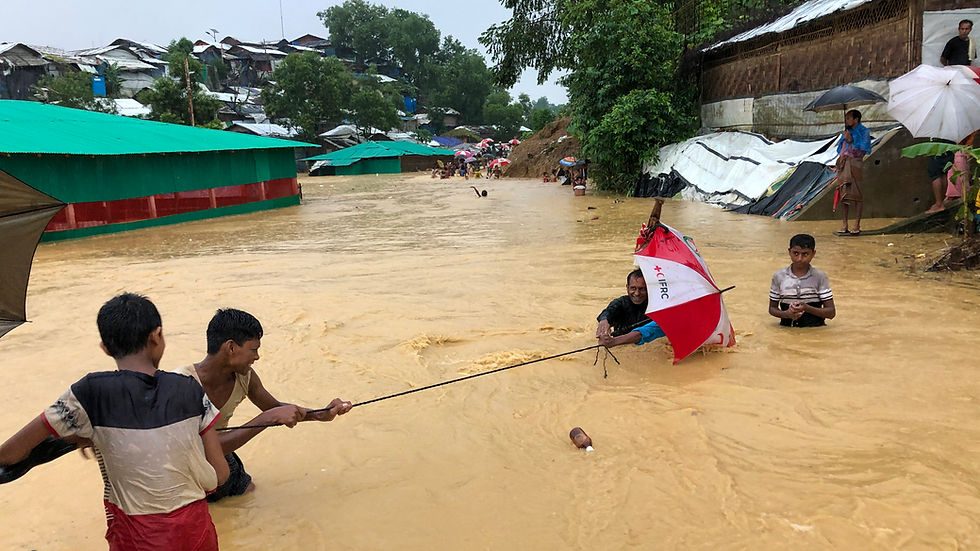

Environmental insecurity is often discussed through statistics: numbers of shelters damaged, families displaced, hectares flooded, or infrastructure destroyed. Yet for camp residents, these events are experienced through uncertainty. Every storm raises questions about what may be lost. Every monsoon requires preparation. Every period of heavy rain carries the possibility of disruption. The anticipation of future instability becomes part of daily life.
The survey findings suggest that many respondents live with a persistent sense of worry and vigilance. The environment helps explain why. In contexts where safety, movement, housing, and infrastructure remain fragile, uncertainty is not an abstract concept. It becomes a practical reality encountered every day. For some residents, however, the landscape generates another kind of anxiety.
Ahtaram Shin has spent years documenting life in the camps while navigating restrictions that shape the movement of refugees throughout the settlements. Reflecting on his experiences, he described how fear became attached to ordinary journeys.
"When I step outside my shelter, the first thought that comes to my mind is whether there are authority and intelligent units. I worry they might check my phone and beat me for using a Bangladesh SIM card."
The concern is not simply about movement. It is about unpredictability. A journey that appears routine can suddenly become dangerous.
Ahtaram continues: "Whenever I cross a police checkpoint or authority, my whole body shakes."
His testimony illustrates how fear can become attached to physical spaces. Checkpoints, roads, camp entrances, and public areas are not experienced in the same way by everyone. For many refugees, these locations carry memories of previous encounters, humiliations, or threats. The geography of the camps becomes intertwined with emotional geography.
This relationship between place and memory is perhaps most visible in the recurring fires that have swept through the settlements. Since 2017, major fires have repeatedly destroyed shelters, schools, mosques, health centres, and community spaces. Entire neighbourhoods have disappeared within hours.
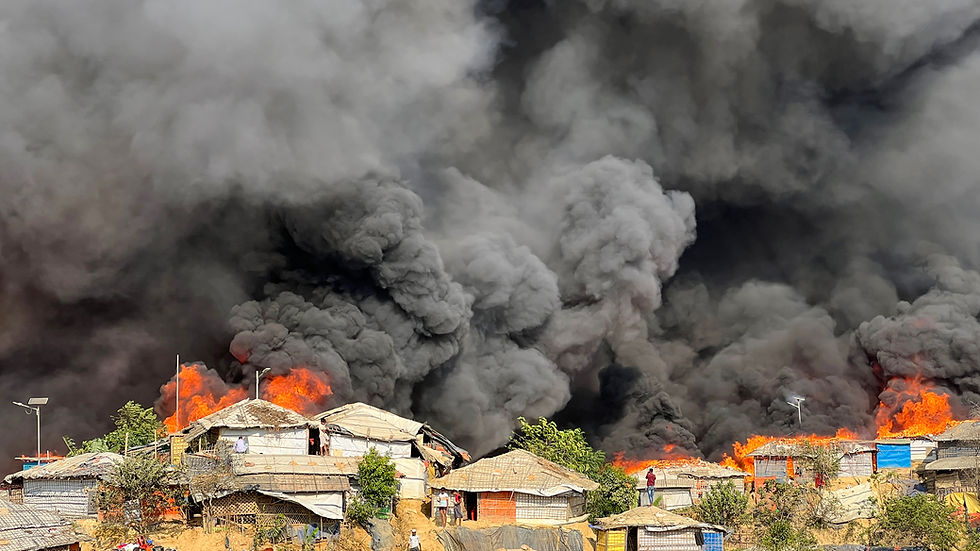

The physical destruction caused by these fires is immense, but their psychological impact often extends far beyond the immediate event. For a population that witnessed villages burned across northern Rakhine State, fire occupies a unique place in collective memory. Camp fires do not simply destroy shelters. They can reactivate memories of earlier losses.
One of the most powerful testimonies collected for this project comes from Zaudha. "Our lives have burnt!"
Her words express something deeper than the loss of a shelter. They speak to the exhaustion of rebuilding after repeated disruption. For many refugees, the fire felt less like a singular disaster and more like another chapter in a longer history of displacement, loss, and uncertainty.


People often speak about losing documents, photographs, medicines, school materials, clothing, and personal belongings during fires. Many families now keep emergency bags prepared. Parents teach children what to save. Important documents are stored carefully and protected whenever possible. The expectation that another disaster may occur becomes woven into daily routines.

The image above captures a striking contradiction. Behind the child stretches a landscape of destruction. Yet life continues. Water is fetched. Shelters are rebuilt. Children return to school. Neighbours assist one another. Communities reorganise themselves around new realities.
Humanitarian narratives often describe this capacity as resilience. The term is not inaccurate, but it can be misleading. Resilience should not obscure the conditions that make repeated adaptation necessary in the first place. People rebuild because they must. The ability to continue does not eliminate the burden of uncertainty.
The Rohingya word oshanti captures part of this reality. It does not refer only to a specific traumatic event. It can also describe the cumulative effect of living in environments where stability remains fragile and the future difficult to predict. Over time, uncertainty ceases to be an interruption to daily life and becomes one of its defining features.
The camps are therefore more than a backdrop to emotional suffering. They form part of its architecture. Floods, fires, restrictions, checkpoints, overcrowding, and environmental vulnerability shape how people move, think, plan, and imagine their futures. They help explain why worry appears so frequently throughout the survey and why so many respondents describe carrying concerns that never seem fully resolved.
The Rohingya have a name for that burden too. They call it dilor sinta. The weight of persistent worry carried from one day to the next.
The Burden of Worry
If oshanti describes the loss of peace, dilor sinta describes the burden that often follows it. It refers to persistent worry, concern, and mental preoccupation. Unlike fear, which is usually attached to a specific threat, worry tends to accumulate. One concern leads to another. Questions remain unanswered. Decisions remain beyond reach. Over time, uncertainty becomes something that accompanies daily life rather than interrupts it.
To better understand how these experiences are distributed across the community, Rohingyatographer contributors conducted a community-led wellbeing survey involving 247 Rohingya participants across the camps. The survey included 56.7% men and 43.3% women, with more than half of respondents aged between 18 and 35. Alongside structured questions, participants contributed testimonies describing their fears, aspirations, frustrations, and everyday experiences. Together, these responses provide a snapshot of how prolonged displacement and uncertainty shape emotional wellbeing across the camps.
Indicator | High Frequency / Severity | Moderate / Sometimes | Low Frequency / No |
Lack of Peace / Sadness | 43.3% (Often) | 46.6% | 10.1% |
Fear and Strong Worry | 47.4% (Daily) | 47.0% | 5.7% |
Community-Led Wellbeing Survey Summary

Taken together, the survey table and graphic reveal a consistent pattern. At the centre sits restricted movement and limited control over daily life. Around this core concern cluster many of the experiences reported by respondents: fear, frustration, social withdrawal, food insecurity, limited educational and employment opportunities, and uncertainty about the future. Emotional wellbeing emerges not as an individual condition alone, but as a consequence of the wider structures shaping life inside the camps.
Several findings stand out. Nearly half of respondents reported feeling angry about restrictions on movement, education, work, or daily life, while similar numbers experienced strong fear or worry almost every day. Almost half said they often withdrew from others when facing difficulties, and large proportions reported body pain, headaches, stomach problems, and a persistent sense of alertness. More than seven out of ten respondents said they had little or no control over major decisions affecting their lives.
This may be the most significant finding in the survey. Fear, frustration, withdrawal, and hopelessness do not emerge in isolation. They develop within a context where many people feel unable to influence the circumstances shaping their lives. The issue is not simply emotional distress, but restricted agency.
The survey was conducted during a period of growing uncertainty surrounding humanitarian assistance. Throughout 2025 and 2026, reductions in international funding led to the closure of health facilities, cuts to essential services, and increasing concern about the future of aid operations. While respondents rarely spoke about funding directly, many described worries about healthcare, food security, education, and basic support systems. These concerns formed part of a broader landscape of uncertainty in which the future felt increasingly difficult to predict.
Recent changes to registration and aid systems added another layer of uncertainty. During 2025, some Rohingya families who refused biometric registration reported losing access to food rations, cooking fuel, healthcare, and other forms of assistance. For those affected, the dispute was not simply about data collection but about trust, identity, and control over decisions that shaped their daily survival. The controversy reinforced a concern that appeared repeatedly throughout the survey: many respondents felt that important decisions affecting their lives were made elsewhere, with little opportunity for participation or consent.
One young woman described how these pressures accumulate across daily life: "As a Rohingya young girl, my mental health is affected by daily stress and uncertainty in camp life, along with limited freedom, education, and opportunities."
The survey also offers important insight into what produces that worry. When respondents were asked about the greatest sources of stress in their lives, the most common answers were not memories of violence or experiences from Myanmar. Instead, people spoke about work, education, food, money, movement restrictions, safety, and uncertainty about the future. Memories of Myanmar remained significant, but for many respondents, the pressures of the present appeared equally urgent.
This finding challenges a common assumption that emotional suffering among refugees is primarily a consequence of past trauma. The survey suggests a more complicated reality. Distress often emerges not only from what people have experienced but also from what they are unable to do.
A recurring theme throughout the survey was the relationship between emotional wellbeing and possibility. Respondents consistently linked their worries not only to present hardships but also to the opportunities they felt unable to access. Education, employment, movement, family reunification, and legal recognition appeared repeatedly as concerns because they represented pathways towards a different future.
Respondents often described a feeling that life had stalled. Education, employment, movement, and family reunification remained uncertain, while long-term planning felt increasingly difficult. The result was not inactivity but suspension: life continued, yet the pathways that normally connect effort to opportunity remained unclear. For younger generations, this suspension is experienced in particularly visible ways.

For Sahal and many others of his generation, the smartphone has become a gateway to worlds they cannot physically enter. Through social media, they follow universities, journalists, activists, athletes, artists, and friends living abroad. They watch people study, travel, work, marry, migrate, and build lives elsewhere.
The survey found that 60% of respondents use social media every day. For many, these platforms provide connection, information, entertainment, and community. Yet they can also intensify awareness of exclusion. 38% reported feeling worse after using social media, a finding that reflects the complicated role digital life now plays within the camps.
The contradiction is striking. The world has never been more visible, yet opportunities to participate in it remain constrained. Information moves freely across borders. People do not. For younger generations, this creates a peculiar form of waiting. They are connected to a global conversation while remaining physically confined within a highly restricted environment. They can observe countless possible futures unfolding on their screens while struggling to identify realistic pathways toward their own.
The survey also reveals how people respond to these pressures. Nearly half of respondents reported withdrawing from others when facing difficulties. Many relied on family members, friends, religious practices, or trusted community figures. The survey found that 42% primarily sought support from religious leaders, while only a small proportion reported accessing formal mental-health or clinical services. Others described carrying their concerns privately, sharing only fragments of what they felt.
Several respondents also described a growing difficulty in knowing whom to trust. Concerns about trafficking networks, exploitation, criminal groups, and political actors operating inside and beyond the camps contributed to a broader sense of insecurity. For some, uncertainty extended beyond institutions and into social relationships themselves. This tendency is reflected in the language people use. Dilor sinta is not panic. It is not crisis. It is the steady accumulation of unresolved concerns. Questions about education, food assistance, documentation, healthcare, family reunification, safety, and opportunity rarely have immediate answers. Yet they continue to shape everyday decisions and future expectations.
The result is a form of emotional labour that often goes unnoticed. People spend years calculating risks, adapting to uncertainty, managing expectations, and negotiating circumstances they cannot control. The effort required simply to maintain hope becomes part of daily life.
Taken together, the findings indicate that one of the most significant psychological consequences of prolonged displacement is not simply trauma, but waiting. Waiting for decisions, opportunities, recognition, and for circumstances to change. Over time, that waiting leaves traces. Not only in thoughts and emotions, but in the body itself.
The Rohingya have words for those experiences too. Some describe them as wounds that remain long after the original injury has passed. Others call them dili zokhom.
Wounds That Remain
Not all wounds belong to the past. Some continue to shape daily life long after the original injury has occurred, while others deepen as new experiences settle upon old ones. Across the camps, many Rohingya describe this condition through the phrase dili zokhom, a wound carried within the heart and mind. The term refers not only to traumatic memories but also to grief, humiliation, separation, fear, and losses that continue to influence how people experience the present.
The idea surfaced repeatedly throughout the survey and interviews conducted for this project. Respondents spoke about worry, sadness, isolation, body pain, sleeplessness, recurring memories, and the difficulty of imagining a future. Yet their experiences rarely pointed to a single cause. More often, suffering appeared cumulative. One event was followed by another. One loss settled upon a previous loss. The result was not a single wound, but a layering of wounds over time.
Few testimonies capture this more clearly than that of Ahtaram Shin. "Trauma has layered upon trauma in my life."
His story begins long before the camps. As a student in Maungdaw during the violence of 2012, he remembers living in constant fear. Travelling through surrounding villages became dangerous. Rumours of beatings, kidnappings, and attacks circulated regularly. At school, he felt stigmatised because of his language, religion, and identity.
"At night, I had nightmares. I could not focus on my studies. My mind was unstable, and my mental health became deeply affected," Ahtaram recalls.
The violence of 2017 did not bring an end to that fear. In Bangladesh, new forms of insecurity emerged. Ahtaram describes anxiety surrounding checkpoints, arbitrary punishment, extortion, robbery, and humiliation.
Recalling one encounter with police after visiting a sick friend in another camp, Ahtaram explains: "The pain was not only physical. What hurt me more was the humiliation."
The distinction is important. Emotional wounds do not arise only from violence itself. They can also emerge from powerlessness, dependency, exclusion, and the repeated erosion of dignity. Throughout his testimony, Ahtaram returns to feelings of fear, withdrawal, and exhaustion. He describes avoiding gatherings, reducing contact with friends, and delaying medical treatment because of anxiety about further humiliation. His experience reflects a broader pattern visible throughout the survey and in Rohingya understandings of suffering. Emotional pain is often carried through the body.

Many respondents described headaches, fatigue, body pain, stomach problems, and chronic physical discomfort alongside experiences of grief, fear, and uncertainty. Rohingya expressions such as gaa bish lager and gaa zoler reflect this relationship between emotional and physical suffering. Rather than separating the body and mind into distinct domains, they recognise that distress frequently moves between them.
Dr Gabor Maté, known for his work on trauma and stress, has argued that the body often carries burdens the mind struggles to express, with prolonged stress and trauma manifesting through physical symptoms as well as emotional distress. Although Rohingya communities use their own language to describe these experiences, the underlying observation is familiar. Worry affects sleep. Fear affects appetite. Grief affects energy. Emotional burdens become physical burdens. For some survivors, however, the body also carries visible evidence of violence.

Saiful's scar records a specific moment in time. Yet like many injuries carried by Rohingya survivors, it functions as more than a physical mark. It becomes a permanent reminder of experiences that continue to shape the present. The same is true for Nabi Ullah.

Violence remains part of contemporary Rohingya experience. News from Myanmar continues to arrive through relatives, social media, and personal networks, bringing reports of renewed conflict, displacement, injury, and death. For many families, the boundary between past violence and present violence is far less clear than outside observers often assume. Sometimes the evidence of that loss can be held in a hand.

The fragment of metal shown above is not simply evidence. It has become a vessel for memory. A small object carrying the weight of an immeasurable absence.

Not every injury is immediately visible. Some survivors carry limitations that shape their daily lives without attracting the same attention as scars or amputations. Foridul Islam's experience reflects this reality. Like many Rohingya, he lives with the long-term consequences of violence and displacement, navigating physical challenges while attempting to sustain a sense of normality inside the camps. His story serves as a reminder that the effects of violence are often measured not only through dramatic moments of injury but through the years that follow.


Abul Alom, 35, was a fisherman from Rathidaung. After escaping renewed fighting between the Arakan Army and the Myanmar military in 2024, he attempted to sustain his family by fishing along the heavily mined border areas surrounding the camps. An explosion destroyed his leg, leaving him permanently disabled.
His story illustrates how violence continues to shape Rohingya lives long after displacement. The injury ended not only his livelihood but also his sense of independence. Family members describe a gradual withdrawal from social life, work, and community activities. What began as a survival response to danger evolved into a deeper isolation.
Some Rohingya describe this condition as bacitakon, a state of profound social withdrawal in which people retreat from relationships, responsibilities, and public life. Although the causes vary, the pattern appears repeatedly throughout the camps among those carrying heavy burdens of grief, injury, loss, or uncertainty. Not all wounds originate in violence. Many emerge through separation.

The Rohingya term dilor furani refers to a profound grief associated with loss and absence. Across the camps, countless families remain divided by borders, conflict, migration routes, detention systems, or economic necessity. Unlike bereavement, separation often offers no closure. People continue to wait for news, for reunification, or simply for certainty. Other forms of suffering are less visible still.

The term bekaar is often translated as unemployment or idleness, but its emotional meaning extends much further. It describes the feeling of being unable to fulfil expected responsibilities, contribute meaningfully to family life, or build a future through one's own efforts. Several respondents linked this sense of stagnation to declining confidence, frustration, and hopelessness.

Fatema's story illustrates how many of these experiences intersect. "As a woman in the camps, I carry worries every day about safety, education, and the future of my children."
The destruction of her village and the later death of her husband are separated by years, yet both remain present in her daily life. Trauma, grief, uncertainty, and memory do not arrive neatly packaged. They overlap, reinforce one another, and become difficult to disentangle.
Taken together, these stories suggest that dili zokhom is not a single condition but a landscape of wounds carried across time. Some originate in violence. Others emerge from grief, humiliation, dependency, separation, or prolonged uncertainty. Their causes differ, but their persistence does not. Unlike injuries that heal and disappear, these experiences continue to shape relationships, decisions, expectations, and everyday life long after the original event has passed.
Yet suffering alone does not define the lives of those who carry it. People continue to raise families, support neighbours, document their communities, pursue education, practise their faith, and imagine futures for their children. The existence of pain does not eliminate agency, even when it complicates it.
For children growing up in the camps, however, these experiences often take different forms. Some memories appear not in words but in drawings. Others emerge through silence, play, or imagination. The emotional consequences of displacement are inherited as well as remembered. To understand how uncertainty shapes the next generation, it is necessary to look at the world through the eyes of children.
Childhood Interrupted
Over half of the Rohingya population in the Cox's Bazar settlements are children under the age of 18. Many were born after displacement and have spent their entire lives in the camps. For many adults in the camps, suffering is measured against memory. They remember villages, farms, schools, markets, neighbours, and lives that existed before displacement. Children often carry a different burden. Many young people have little or no memory of Myanmar at all. Their understanding of home is often inherited through stories, photographs, and the memories of parents and grandparents. For older generations, however, the situation is reversed. Memories of Myanmar often remain more tangible than the future itself. The past can be recalled in detail; the years ahead are far harder to imagine.

These restrictions unfold alongside material challenges that directly affect child development. In 2025, humanitarian agencies reported a Global Acute Malnutrition rate of 15.1% among Rohingya children, exceeding the World Health Organisation’s emergency threshold. The finding is a reminder that prolonged displacement leaves traces not only in aspirations and opportunities but in physical development itself.
For children who have spent most or all of their lives inside the camps, restrictions on movement and education are not temporary interruptions but conditions that shape their understanding of what adulthood may become. The consequences are visible not only in conversations but also in drawings, photographs, and the ways children imagine themselves and their futures. One of the most striking examples comes from Omair.
The images he creates are often filled with scenes of violence, loss, and fear. "He survived the conflict, but the memories survived with him," Ajida explained. "His drawings are not dreams; they are echoes of pain. While others draw happiness, Omair draws what he cannot forget."

The observation captures a reality familiar to many families. Experiences of violence do not disappear simply because children survive them. Memories may remain fragmented, incomplete, or difficult to express verbally, yet they continue to surface through play, behaviour, stories, and creative expression.
For children born after displacement, the transmission of memory often occurs differently. They inherit experiences they did not directly witness. Family stories, conversations, photographs, and collective remembrance become part of their understanding of themselves and the world around them. This process is visible in their drawings.
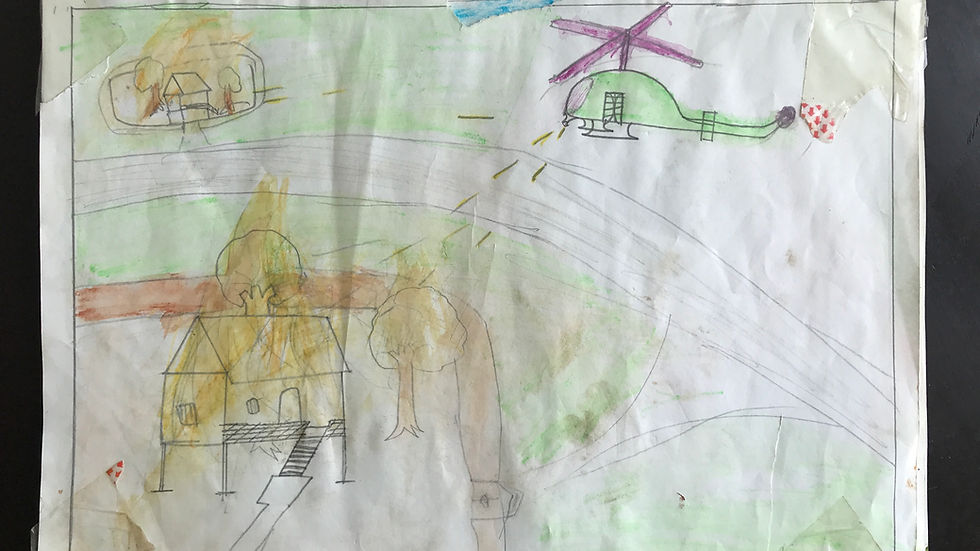
The image does not function as evidence in the conventional sense. It cannot be analysed through statistics or policy frameworks. Yet it reveals something equally important: the emotional landscapes children inhabit and the stories they absorb from the adults around them.
The survey findings discussed in earlier chapters suggest that uncertainty about the future is one of the most significant sources of distress among adults. For children and adolescents, this uncertainty often intersects with education.
For years, Rohingya families have viewed education as one of the few available pathways toward a different future. Yet opportunities remain limited, particularly for older adolescents. Recent studies found that while approximately three-quarters of younger children were participating in learning programmes, attendance among girls aged fifteen to eighteen fell dramatically, reaching single digits in some surveys. Funding reductions and the closure or downsizing of learning centres have further restricted opportunities for many young people. The consequences extend beyond schooling itself. Education provides structure, routine, social connection, aspiration, and a sense of progression. When those pathways narrow, uncertainty expands.
Educational restrictions emerged repeatedly throughout interviews and survey responses, but they carry particular weight when considered from the perspective of younger generations. For many adolescents, the challenge is not simply a lack of educational opportunities. It is the absence of clear routes from education into adulthood. One family described this condition through the experience of Mohammed Ali.


Mohammed Ali's father offered a description that is difficult to forget: "Mohammed describes himself as only half alive."
The phrase is striking because it expresses more than sadness. It suggests interruption. A life that continues but does not feel complete. A future that remains difficult to imagine. Many adolescents interviewed during this project described similar feelings, though often in different words. They spoke about wanting to study, travel, work, develop skills, support their families, or contribute to their communities. Yet they also spoke about uncertainty, restrictions, and the difficulty of turning aspirations into reality.
The result is a peculiar condition. Childhood continues. Adolescence continues. People grow older. Yet the milestones that normally mark transitions into adulthood often remain suspended.
This reality is visible throughout the camps. Young people attend workshops, participate in photography projects, study languages, learn technical skills, and pursue education wherever possible. Families continue to invest in their children's futures even when the available pathways remain uncertain.
What emerges is not a generation defined by hopelessness, but a generation living within contradiction. Young Rohingya are deeply connected to the wider world through education, technology, media, and social networks. At the same time, many remain physically confined within systems that offer limited opportunities to act on those connections.
The emotional consequences are difficult to measure. Some appear through anxiety, frustration, or withdrawal. Others emerge through drawings, stories, photographs, or moments of silence. The effects are rarely uniform, yet they point toward a broader question. What happens when childhood unfolds inside a condition that was never intended to last this long?
The answer cannot be found in policy reports alone. It is visible in classrooms, in family conversations, in sketchbooks, and in the aspirations young people continue to hold despite the circumstances surrounding them. And increasingly, it is visible through the cameras they carry themselves.
Beyond Survival
By the time conversations turn to mental health, suffering often dominates the discussion. People speak about trauma, loss, grief, anxiety, depression, and distress. These experiences are real and appear throughout the survey findings documented in this article. Yet focusing exclusively on suffering risks creating a distorted picture of everyday life. Even under conditions of prolonged displacement, people continue to seek meaning, maintain relationships, care for one another, learn new skills, practise their faith, and imagine futures for themselves and their children.
The survey revealed this repeatedly. Alongside questions about fear, worry, and emotional wellbeing, respondents were asked where they found support during difficult periods. Many described turning first to family members, friends, neighbours, religious leaders, and community networks rather than formal services. Emotional wellbeing was rarely understood as an individual matter. It was experienced collectively, through relationships and shared forms of belonging.
For one woman, wellbeing was defined less by the absence of hardship than by the ability to continue despite it: "Mental health, for me, is the quiet strength inside a person, the ability to keep going, to hope, and to find a little peace even when life feels heavy."
For younger generations, these forms of support are especially important. Many children have spent their entire lives inside the camps. They have grown up within restrictions that previous generations experienced only after displacement. Yet childhood continues. Friendships form. Games are invented. Lessons are learned. Families celebrate milestones. Life develops within the boundaries imposed upon it.


Children do not spend every moment thinking about displacement. They play, argue, laugh, learn, and imagine like children everywhere. Their lives are shaped by extraordinary circumstances, but they are not defined entirely by them. This distinction matters because humanitarian narratives often struggle to represent ordinary life. Suffering is visible. Everyday existence is harder to document.

Yet everyday life in the camps cannot be reduced to suffering alone. Alongside uncertainty and hardship, people continue to study, teach, organise, create, and support one another. Informal study groups, language classes, photography workshops, youth initiatives, and community-led projects provide opportunities to learn, share knowledge, and participate in community life. These activities do not remove uncertainty, but they help counteract one of its most corrosive effects: the feeling that life has stopped moving forward.
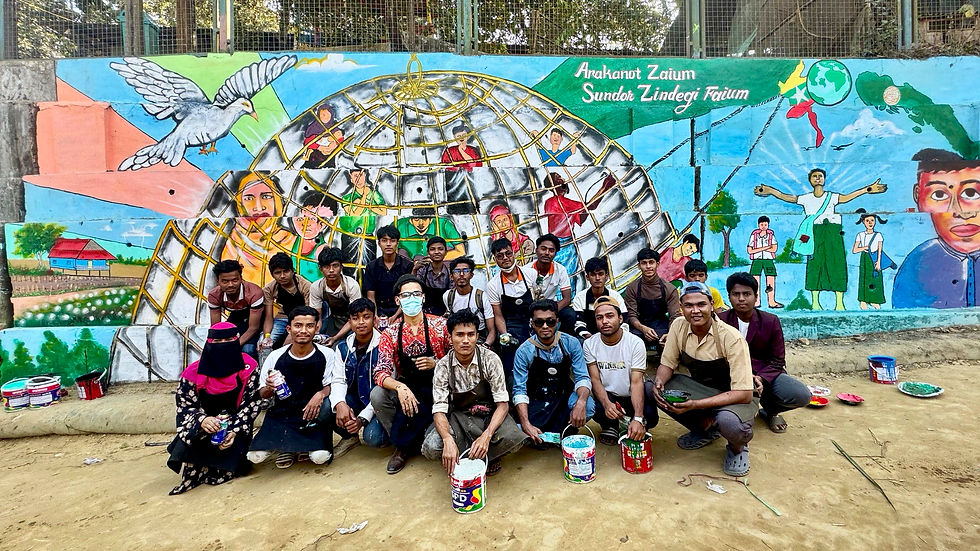
Recognition matters as well. Throughout workshops and other community initiatives, young people frequently speak about the importance of certificates, publications, exhibitions, and public acknowledgement. In a context where legal recognition remains absent and opportunities for advancement are restricted, evidence of effort becomes especially meaningful. A certificate, published photograph, completed course, or community role represents more than accomplishment. It confirms that learning has value, that contribution matters, and that personal growth remains possible.

Faith occupies a similarly important place in many people's lives. Earlier survey findings showed that a significant proportion of respondents sought support from religious leaders during periods of emotional distress. Prayer, religious study, and communal worship were frequently described not only as spiritual practices but also as sources of stability.

For many respondents, faith provided a framework through which suffering could be understood and endured. It offered continuity with life before displacement while also creating a language through which uncertainty could be interpreted. Religious practice did not eliminate grief, fear, or worry, but it often helped people situate those experiences within a larger moral and spiritual horizon.

As daylight fades, communal prayer brings people together in ways that transcend the practical realities of camp life. These moments are easy to overlook because they rarely appear in reports about refugee wellbeing. Yet they form part of the social infrastructure through which communities sustain themselves. Alongside family relationships, friendships, education, storytelling, music, and cultural traditions, they help preserve continuity in circumstances defined by disruption.
The importance of these practices becomes clearer when viewed alongside the survey findings presented in earlier chapters. If prolonged displacement creates conditions of uncertainty, then meaning-making becomes one way of resisting that uncertainty. People continue to teach, learn, pray, document, organise, create, and support one another not because their circumstances are easy, but because life continues despite them.
This observation is important because it challenges a common misconception. The Rohingya are often portrayed either as victims or as examples of resilience. Neither description is sufficient. Victimhood emphasises suffering while overlooking agency. Resilience emphasises adaptation while overlooking the structures that make adaptation necessary. Everyday life inside the camps is more complicated than either category allows. People are not simply surviving. They are attempting to build meaningful lives within conditions they did not choose and cannot fully control.
The question, then, is not only how people endure uncertainty. It is also how they continue to represent themselves within it. Increasingly, one answer can be found through the photographs, stories, and visual archives they create for themselves. That is where the camera enters the story.
Seeing Ourselves
Throughout this article, photographs have served as evidence. They have documented flooded pathways, burned shelters, physical scars, family histories, childhood memories, religious practice, and everyday life inside the camps. Yet photographs do more than record events. They shape how people understand the world and how the world understands them.
For decades, images have played a central role in defining international perceptions of the Rohingya. Photographs of overcrowded boats, refugee camps, aid distributions, and humanitarian emergencies have circulated widely through newspapers, reports, fundraising campaigns, and social media. Many of these images helped expose atrocities and draw attention to a crisis that might otherwise have remained invisible. Yet they also raised a fundamental question: who controls the visual record?
Susan Sontag, one of the most influential cultural critics of the twentieth century, observed that photographs do not simply reflect reality; they influence what societies choose to see, remember, and ignore. For communities repeatedly photographed by outsiders, this creates a particular challenge. If others are always producing the images, others are also helping determine how the community is perceived. The question is therefore not only what is photographed, but who decides what becomes visible.
Rohingyatographer emerged partly in response to that question. Rather than documenting refugees from the outside, the project sought to create opportunities for Rohingya to document themselves. Cameras became tools not only of observation but of participation. Photography was no longer simply a method of recording events. It became a means of interpretation, communication, reflection, and authorship.
The distinction matters because self-representation changes the kinds of stories that enter the archive. Throughout this project, contributors documented subjects that rarely appear in conventional humanitarian imagery: music, friendship, learning, prayer, boredom, family relationships, community gatherings, aspiration, grief, humour, and everyday routines. These photographs do not replace images of suffering. They expand the picture.
For many contributors, photography also became a way of analysing the systems surrounding them. Reflecting on years spent navigating camp structures and humanitarian institutions, Ahtaram Shin described the imbalance through a metaphor that has remained difficult to forget.

"The monkey rules the owl while the fox manipulates the labour of others," Ahtaram metaphorically expressed.
The phrase resists precise translation, but its meaning is clear enough. Knowledge, power, and responsibility do not always align. Those who understand a situation most intimately are not always those making decisions about it.
Ahtaram's own experience reflects this contradiction. For six years he worked as a researcher and writer for an international humanitarian organisation, receiving 600–700 taka per day (approximately US$5) and no formal credit for his work. He eventually resigned, describing the volunteer system as a form of labour that extracted knowledge while offering little recognition in return.
Similar concerns appeared throughout interviews conducted for this project. Many respondents described feeling excluded from processes that directly affected their lives. Photography became one response to that imbalance, not by replacing existing institutions, but by producing knowledge grounded in lived experience.
The importance of authorship becomes even clearer when authorship is denied. Many Rohingya photographers have watched their images circulate widely online without permission, payment, attribution, or consent. Photographs created under difficult circumstances frequently appear in media coverage, organisational communications, and social-media accounts while the people who produced them remain invisible. The problem has been documented by journalist Shafiur Rahman, who has written extensively about the unauthorised use of Rohingya-produced images and the lack of recognition afforded to the photographers behind them.
The issue is not merely professional; it is political. A community that struggles for recognition in law, citizenship, and public life often encounters similar struggles in the realm of representation. Questions of ownership, credit, and consent therefore become inseparable from broader questions of dignity and power. Who owns an image? Who benefits from its circulation? Who receives recognition for producing it? These questions help shape the conditions under which people participate in public life.
Photography also creates something less tangible but equally important: recognition. Not recognition from governments, legal systems, or international organisations, but recognition from other human beings. The acknowledgement that a person's experience matters, that their perspective has value, and that they are capable of producing knowledge rather than merely becoming its subject.
The value of that recognition surfaced repeatedly throughout Rohingyatographer workshops and publications. Young contributors often spoke about the significance of seeing their names attached to photographs, articles, exhibitions, and magazines. Publication did more than circulate information. It confirmed that their work mattered and that their perspectives belonged within public conversations.
One phrase emerged repeatedly during these discussions: “Truth is the lens. You don't need expensive equipment to tell a powerful story; you need honesty, purpose, and the courage to share it.”
The statement is intentionally simple, yet it captures something fundamental about the project. Cameras matter. Training matters. Publications matter. But the most important element remains the act of paying attention. Photography begins with observation before it becomes documentation. It begins with witnessing before it becomes evidence.
Taken together, the photographs gathered throughout this article form an alternative archive of displacement. They were created not by observers passing through the camps, but by people living their realities every day. Their significance lies not only in what they reveal to external audiences but in the space they create for Rohingya communities to see, document, and interpret themselves on their own terms. The result is not simply a collection of images. It is a claim to authorship. And, perhaps more importantly, a claim to existence.
The Question of Tomorrow
The survey that forms the backbone of this article began as an effort to understand mental health among Rohingya refugees. Participants were asked about fear, worry, sadness, social withdrawal, bodily symptoms, support systems, and daily experiences. Yet as responses accumulated, a different picture emerged. Again and again, people returned to the same concerns: movement, education, documentation, work, family separation, recognition, and the future.
During a joint visit to the camps with UN Secretary-General António Guterres in March 2025, Bangladesh's Chief Adviser Muhammad Yunus [expressed](https://www.daily-sun.com/post/796

