


Timeline of Rohingya Displacement: A Century of Exile and Survival

Updated: Apr 13
A story by Azim Ullah and Ahtaram Shin. Edited by David Palazón.
Produced with the support of the Global Statelessness Fund.

For decades, the Rohingya people have endured a cycle of displacement due to oppression and discrimination in their homeland of Arakan State. While international discourse often views the 2017 exodus as a singular crisis, historical records indicate it was the final phase of a decades-long process of exclusion and periodic expulsion. This process has transformed an indigenous community with roots dating back to the 15th-century Arakan Kingdom into the world’s largest stateless population.
This story follows seven elders: Ali Akbar, Lalmia, Hassan Ahmed, Sha Alom, Roshida Begum, Goramia, and Nurul Hoque, whose lives bear witness to that history. Each has been displaced three or more times. Their testimonies are not isolated memories, but living records of a policy of erasure that has unfolded over nearly a century.
Their voices anchor this narrative. Around them sits a broader historical frame: military operations, legal exclusion, and administrative controls that progressively transformed an indigenous population into the world’s largest stateless community.

Historical Context and the 1962 Rupture
Following Myanmar's independence in 1948, the government initially recognized the Rohingya as a legitimate ethnic group. Under the 1948 Union Citizenship Act, the community was granted the right to vote, and several Rohingya were elected to Parliament.
This recognition ended after the 1962 military coup, which introduced a doctrine of "Burmanization" that prioritized Buddhist identity and targeted minorities. In 1974, a new constitution and the Emergency Immigration Act provided the framework for further marginalization. Authorities began confiscating National Registration Cards (NRC) from Rohingya residents and replacing them with "Foreign Registration Cards" that identified them as non-citizens.
Over subsequent decades, the Myanmar government issued and revoked multiple forms of identity documents specifically for the Rohingya. These included: National Registration Cards (NRC), AK Cards, three-fold MDW cards, Temporary White Cards, receipt cards, and later the National Verification Card (NVC), which many refugees view as a "genocide card" because it classifies them as foreigners.
From left to right: AK Card, White Card and Receipt Card. 2026 © Azim Ullah.
While other ethnic groups transitioned from the NRC to full National Identity Cards, Rohingya documentation was repeatedly confiscated or downgraded to temporary status. These administrative shifts served as "lawfare" and using legislation and documentation to dehumanise the population and provide legal justification for their eventual removal.
For families like those of Sha Alom and Goramia, preserving these fragile, worn papers became a vital act of survival. These documents remain the only physical proof of their roots and their family's testimony of belonging to a homeland that has systematically tried to rewrite their history.
1978: Operation Nagamin (Dragon King)
Ali Akbar, now 80, and his wife Nobishuna, 74, are from Buthidaung. They raised five children, two sons and three daughters, while enduring three waves of forced displacement
.
In 1977–78, the military junta under General Ne Win launched Operation Nagamin (Dragon King), officially to identify so-called “illegal immigrants” ahead of a national census. In practice, it involved widespread arrests, torture, sexual violence, and the burning of Rohingya villages across northern Arakan.
Ali Akbar and his family held AK Cards while attempting to apply for nationality. During the operation, soldiers confiscated their documents and burned their home, forcing them to flee across the Naf River into Bangladesh. By May 1978, an estimated 200,000 to 250,000 Rohingya had been forced to seek refuge in Bangladesh, leaving Myanmar under extreme coercion. In this tense situation, the Ali Akbar family was displaced for the first time.
“We were forcibly displaced three times — first in 1978, second in 1992, and most recently in 2017. We have spent our lives in a cycle of displacement,” said Ali Akbar.
Conditions in the emergency camps were inadequate, and between 10,000 and 40,000 refugees died from hunger and disease. To pressure families to return to Myanmar, the Bangladeshi government restricted food rations. While a bilateral agreement led to the repatriation of approximately 200,000 survivors by 1979, the process was often involuntary. Ali Akbar and his family were among those who returned after several months to attempt to rebuild their lives. However, many returnees found their land had been seized by the state or neighboring communities, and their legal and social status was further degraded.

1982: The Legalisation of Statelessness
Between displacement waves, the legal foundations of exclusion hardened. The 1982 Burma Citizenship Law replaced the inclusive 1948 Union Citizenship Act and introduced a tiered citizenship system. Section 2(c) and (d) of the law introduced the categories of Associate Citizen and Naturalized Citizen, tiers designed for those who could not qualify for full citizenship.
First page of the 1982 Burma Citizenship Law in both its original Burmese version and the official English translation.
Under this framework, full citizenship was restricted to "national races" (taingyintha) that could prove their presence in Myanmar prior to 1823, the start of the first Anglo-Burmese War. The government published a list of 135 recognized ethnic groups considered indigenous under this 1823 Rule; the Rohingya were omitted from this list.
This omission rendered the community effectively stateless. Without recognized citizenship, the Rohingya became vulnerable to arbitrary arrest, forced labor, and strict movement restrictions. This application of "lawfare" used legislation to dehumanise the community and established the legal grounds for the next waves of displacement.
1991–1992: Operation Pyi Thaya (Clean and Beautiful Nation)
Under the State Law and Order Restoration Council (SLORC), the military launched Operation Pyi Thaya, also known as “Clean and Beautiful Nation.” Officially framed as a counter-insurgency campaign, it targeted civilians through forced labor, rape, arbitrary detention, and land confiscation. More than 250,000 Rohingya fled to Bangladesh during this period.
“During this time, we were facing famine. We had no livelihood, nothing to eat, no income, no safety, and no water. All basic resources were blocked by the authorities, forcing us to flee to Bangladesh again in 1992,” said Ali Akbar.
During Operation Pyi Thaya, soldiers inspected individuals for a right deltoid scar left by a common vaccination. The military used these marks to accuse Rohingya of being "Bengali". Those identified with the scar were sentenced to several months in jail. During this period, the state confiscated AK cards and issued temporary White Cards in their place. This administrative downgrade occurred while other ethnic groups were receiving full National Identity Cards (NID), further reinforcing the message that Rohingya did not belong.
1994–2012: The Era of Administrative Persecution
Between major waves, the Rohingya lived under a regime of "slow-motion" persecution enforced by the NaSaKa border security force. This included:
Mandatory permits for marriage, which were difficult to obtain.
Denial of birth certificates for children starting in 1994.
Strict movement restrictions between villages.
Periodic forced labor for military infrastructure projects.
Lalmia, now 88 years old and residing in Camp 22, lived through these systematic challenges in Maungdaw. His life, like many others, has been defined by this administrative oppression and the survival of three major waves of displacement in 1978, 1992, and 2017.

Hassan Ahmed, 74 years old, was born and raised in Buthidaung. Once a respected community member and humanitarian worker, he was displaced four times: in 2000, 2012, 2014, and 2017. Each time violence broke out, it destroyed whatever small sense of stability he had managed to rebuild. Homes were burned, communities were terrorized, and fear became part of everyday life.
For years, his survival meant repeatedly crossing the Naf River back and forth between Myanmar and Bangladesh. It was not by choice, but by necessity. That river, once a source of livelihood and a simple geographic border, became a painful symbol of displacement, uncertainty, and survival. His life has been marked not by peaceful aging, but by escape, return, and escape again.
“That river became a symbol of survival,” Hassan said. “Not by choice, but by necessity.”

Sha Alom, aged 64, is originally from Nga Sa Phyo village in northern Maungdaw. His life has been marked by repeated waves of violence and forced displacement in 1991–92, 2012, and 2016–17, reflecting the long-standing pattern of persecution faced by the Rohingya community.
Sha Alom safeguarded his family’s generational documents, including identity records belonging to his father, grandparents, and great-grandparents. Although his home was destroyed and he was driven out of the country, he managed to preserve some of these documents as evidence of their identity, in the hope of seeking justice and reclaiming their denied rights.
“These worn and fragile papers are proof of my roots and my family’s identity,” Sha said. “They are more than just documents. They are our testimony.”

2012–2015: Communal Violence and Exodus by Sea
In 2012, communal violence erupted across Rakhine State. Unlike earlier military-only operations, local militias and civilians participated, often with the support or acquiescence of security forces. Around 140,000 Rohingya were displaced internally into camps near Sittwe.
Between 2012 and 2015, the desperation following communal violence led an estimated 112,500 to 170,000 people to flee via the Bay of Bengal and Andaman Sea. Many boarded dangerous, rickety boats operated by human traffickers with the goal of reaching Malaysia.

This route became one of the deadliest in the world; thousands drowned when vessels capsized, while others were held for ransom in jungle camps or left stranded at sea after being abandoned by traffickers. Many never arrived. This led to a regional crisis in SouthAsia as nations initially refused entry, resulting in the "ping-pong" policy and tragic loss of life at sea and in jungle camps.
2017: Genocide and Mass Displacement
On August 25, 2017, the Myanmar military launched "clearance operations" characterized by mass killings and the burning of approximately 400 villages. Entire villages were surrounded, shelled, and burned within hours. Within the first 30 days, at least 6,700 Rohingya were killed, including at least 730 children.
The United Nations described these operations as a "textbook example of ethnic cleansing," and independent investigators have since provided evidence of genocide. An estimated 740,000 Rohingya fled to Bangladesh within weeks, joining those from previous waves to create a settlement that now hosts over 1.3 million people.

“The most devastating wave I ever saw in my life,” Ali Akbar said. “All Muslim villages across northern Rakhine were burned.”

Roshida Begum, 67, from Khawar Village in Maungdaw, was first displaced in 1978 as a child during Operation Nagamin. She was only five when soldiers came to her village. She fled again during the 2012–2014 unrest when her village was attacked and burned. In 2017, as a mother and grandmother, she crossed the Naf River for the third time, seeing her community destroyed once again. In 2017, she crossed the Naf River into Bangladesh for the third time—this time as a mother and grandmother witnessing the destruction of her community once more. Her life is defined by a cycle of escape and survival, carrying a lifetime of trauma.
“From the age of five to sixty-seven, I have spent my life escaping oppression,” Roshida said. “Our lives are ending in a very dark and painful way.”
The Evidence of Belonging
Despite the repeated destruction of their homes, Rohingya elders managed to preserve family documents as evidence of their roots and identity. These documents include the National Registration Card (NRC), AK Card, MDW (three-fold cards), and Family Registration Documents.
Goramia, 98, is from Rathedaung in Arakan State. He survived three waves of violence in 1978, 1991–92, and 2017. Now he lives in Unchiprang Camp-22. Through every displacement, he carefully protected his family documents.
"I protected to these fragile papers as records of my identity, ancestry, and belonging. They are not just documents, for me they are proof that I had a homeland and I still call my own," Goramia noted.


Life in Limbo
Today, the Rohingya in Bangladesh are officially classified as Forcibly Displaced Myanmar Nationals, not refugees. The distinction is administrative, but its consequences are total: no formal legal status, no right to work, no freedom of movement, no pathway to citizenship.
The stories of Ali Akbar, Lalmia, Hassan Ahmed, Sha Alom, Roshida Begum, Goramia, and Nurul Hoque are not isolated memories of displacement. They are living records of a systematic history that spans generations.
These elders grow old in crowded camps, surrounded by fading photographs and fragile identity papers that have outlasted the regimes that tried to erase them. These documents do not merely record the past; they stand as evidence that belonging existed long before it was criminalised, and that it persists, even in exile.
Their preserved papers and photographs testify that the Rohingya belonged to their homeland long before violence attempted to rewrite that truth. Yet today, these men and women remain in Bangladesh, still waiting for recognition, justice, and the simple right to live freely and safely in the land they continue to call Arakan.
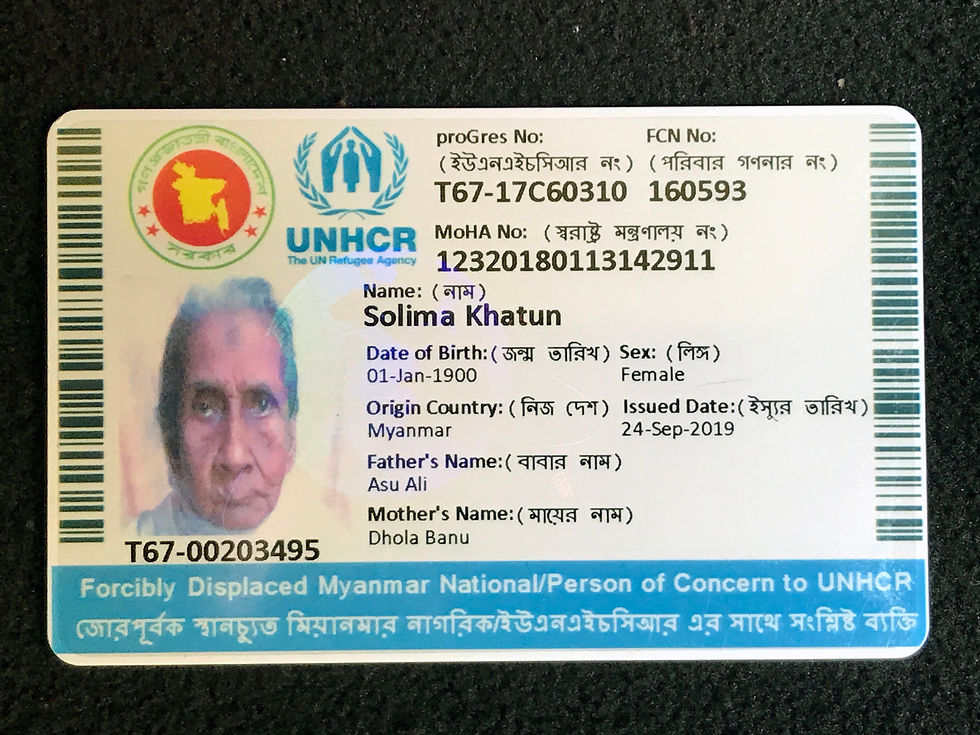
For many, the only official proof of existence now takes the form of a UNHCR registration card. Issued in exile, the card reduces a lifetime to a photograph, a number, and a date of birth that is often no more than an administrative placeholder, frequently recorded as "1 January" of an unspecified year when no documents survived the fires, the rivers, or the flight. Biometric data is captured with precision, while personal history is flattened into approximation. Identity is measured, stored, and managed, but never restored. The card allows access to aid. It does not confer rights. It confirms displacement, not belonging.
History of Forced Displacement (1784–2026)
The following table summarises the major waves of displacement that have shaped the lives of the Rohingya.
Date / Period | Event / Operation | Reasons / Details | Displacement Figures | Casualties (Injured/Killed) | Return Status |
1784 | Burmese Conquest of Arakan | King Bodawpaya invaded/annexed Arakan. Oppression forced Arakanese (Muslim and Buddhist) to flee to British-controlled Bengal. | Thousands fled to the Cox’s Bazar area. | Noted as a "bloody annexation". | Many settled permanently; some returned after British colonization of Burma in 1824. |
1942 | WWII Communal Violence | British retreat/Japanese invasion triggered violence between Rakhine Buddhists and Rohingya Muslims. Muslims fled north; Buddhists south. | ~22,000 to 80,000 fled to Bengal (East Pakistan). | ~100,000 Muslims massacred; 307 villages destroyed. | Some returned with the British (1945), but many were blocked or considered illegal. |
1948 | Union of Burma Independence | Post-independence tensions. The Burma Territorial Force (BTF) conducted operations against Rohingya. | 30,000 to 50,000 fled to East Pakistan. | Unspecified massacres and village burnings. | Unspecified. |
1959 | Evictions | Immigration officials uprooted Rohingyas from villages in Maungdaw and Buthidaung. | Thousands pushed into East Pakistan. | Unspecified; reports of torture. | Accepted back after protests from Pakistan. |
1978 (Feb–July) | Operation Naga Min (Dragon King) | Census/immigration check to screen "foreigners." Army brutality, rape, and murder reported. | 200,000 to 300,000 fled to Bangladesh. | 10,000 to 40,000 died in refugee camps from hunger and disease. | Returned. ~187,000 to 200,000 repatriated (1978–79) under bilateral agreement, often involuntarily. |
1991–1992 | Operation Pyi Thaya (Clean & Beautiful Nation) | Military buildup, forced labor, rape, and persecution after the 1990 election. | 250,000 to 270,000 fled to Bangladesh. | Summary executions, beatings, rape. | Returned. Between 1992–2005, ~230,000 repatriated (many forcibly coerced). |
2012 (June & Oct) | Communal Violence | Sparked by rape/murder of a Buddhist woman. Riots and arson between communities. | ~140,000 internally displaced (IDPs) to camps. Tens of thousands fled to Bangladesh by boat. | 192 killed (official); others estimate higher. Muslim properties disproportionately destroyed. | No. Most remain confined in IDP camps or fled abroad; return to villages denied. |
2012–2015 | Andaman Sea "Boat Crisis" | Fleeing persecution and IDP camps via smugglers/traffickers. | ~170,000 fled by sea to Thailand, Malaysia, and Indonesia. | Hundreds died at sea from starvation, drowning, or abuse. | No. Many remain in Malaysia, Thailand, Indonesia; some pushed back to sea. |
2016 (Oct) | "Clearance Operations" | Military response to attacks on border posts by Harakah al-Yaqin (ARSA). | ~70,000 to 90,000 fled to Bangladesh. | "Hundreds" killed; mass rape/village burnings. | No. Merged with larger 2017 influx. |
2017 (Aug) | "Clearance Operations" (Genocide) | Massive military response to ARSA attacks. UN described as "textbook ethnic cleansing"/genocide. | 700,000 to 800,000+ fled to Bangladesh. | 6,700 to 13,750+ killed in first month (730 children). 354 villages destroyed. | No. Failed repatriation attempts in 2018/2019 due to lack of rights/safety. |
2021 (Feb) | Military Coup (Tatmadaw) | Junta seized power. Worsening security, "slow genocide" via blockades. | Internal Displacement.600,000 Rohingya remain trapped in Rakhine. | ~38,000 civilians killed nationally (all groups) since coup. | No. Conditions not conducive for return. |
2023 | Camp Fires & Cyclone Mocha | Arson attacks and environmental disasters destroyed shelters. | ~40,000 refugees lost shelters in camps. | Unspecified deaths/injuries from disasters. | No. "Pilot project" for return discussed but stalled. |
2024 | Civil War & Forced Conscription | Arakan Army (AA) vs. Junta fighting. Junta enforced conscription of Rohingya. | 65,000 to 70,000+ new refugees crossed to Bangladesh. | High. 200+ killed in Naf River massacre (Aug); thousands killed in conflict. | No. |
Jan 2025–2026 | Current Status | Ongoing conflict; famine risk. Surge in boat departures. | 3,100 attempted sea journeys (Jan–May 2025). 1,133,981 total refugees in Bangladesh (Apr 2025). | 457 died or missing at sea (Jan–May 2025). Total dead or missing since 2022: 1,878. | No. Repatriation remains stalled. |
Bibliography
Alam, Jobair. (2019). "The Current Rohingya Crisis in Myanmar in Historical Perspective." Journal of Muslim Minority Affairs, 39(1), 1–25.
Ärzte ohne Grenzen (Doctors Without Borders). "10 years for the rohingya refugees in bangladesh: past, present and future." Accessed February 17, 2026.
Ba Tha. (1960). "Rowengyas in Arakan." The Guardian Magazine, 7(5), 33–36.
Bhatia, A., et al. (2018). "The Rohingya in Cox's Bazar: When the Stateless Seek Refuge." Health and Human Rights Journal, 20(2), 105-122.
Burke, Adam. (2016). "New Political Space, Old Tensions: History, Identity and Violence in Rakhine State, Myanmar." Contemporary Southeast Asia, 38(2), 258–283.
Charney, Michael W. (1999). Where Jambudipa and Islamdom Converged: Religious Change and the Emergence of Buddhist Communalism in Early Modern Arakan (Fifteenth to Nineteenth Centuries). PhD Dissertation, University of Michigan.
Charney, Michael W. (2000). "A Reinvestigation of Konbaung-era Historiography on the Beginnings of the Relationship Between Arakan and Ava (Upper Burma)." Journal of Asian History, 34(1), 53-68.
Charney, Michael W. (1998). "Rise of a Mainland Trading State: Rahkaing Under the Early Mrauk-U Kings, c. 1430-1603." Journal of Burma Studies, 3, 1-33.
Cheesman, Nick. (2017). "Introduction: Interpreting Communal Violence in Myanmar." Journal of Contemporary Asia, 47(3), 335-352.
Council on Foreign Relations. "The Rohingya Crisis."
D’Hubert, Thibaut. (2015). "The Lord of the Elephant: Interpreting the Islamicate Epigraphic, Numismatic, and Literary Material from the Mrauk U Period of Arakan (ca. 1430–1784)." Journal of Burma Studies, 19(2), 341-370.
Doctors Without Borders. "A timeline of the Rohingya crisis."
Eaton, Richard M. (1993). The Rise of Islam and the Bengal Frontier, 1204–1760. Berkeley: University of California Press.
European Commission. "The Rohingya crisis."
Farzana, Kazi Fahmida. (2017). Memories of Burmese Rohingya Refugees: Contested Identity and Belonging. New York: Palgrave Macmillan.
Fortify Rights. (2019). Tools of Genocide: National Verification Cards and the Denial of Citizenship of Rohingya Muslims in Myanmar.
The Guardian. "Refugees + Internally displaced people."
The Guardian. "Rohingya."
The Guardian. "Rohingya crisis: Amnesty accuses Myanmar of crimes against humanity."
The Guardian. "The Guardian view on the forgotten Rohingya refugees: lives without futures | Editorial."
The Guardian. "The Rohingya crisis, a year on: four generations of one family on life in limbo."
The Guardian. "The Rohingya refugee crisis speaks to the worst acts of humanity."
German National Library. "Documentation of human rights abuses among Rohingya refugees from Myanmar."
Habib, Mohshin, et al. (2018). Forced Migration of Rohingya: The Untold Experience. Ontario International Development Agency.
Haque, Md. Mahbubul. (2017). "Rohingya Ethnic Muslim Minority and the 1982 Citizenship Law in Burma." Journal of Muslim Minority Affairs, 37(4), 454-469.
Human Rights Watch. (1996). Burma: The Rohingya Muslims: Ending a Cycle of Exodus?
Human Rights Watch. (2000). "Burmese Refugees In Bangladesh."
International Rescue Committee (IRC). "Rohingya refugee crisis: Violence displaces thousands in Myanmar's Rakhine State."
Kipgen, Nehginpao. (2019). "The Rohingya Crisis: The Centrality of Identity and Citizenship." Journal of Muslim Minority Affairs, 39(1), 61-74.
Leider, Jacques P. (2018). "Rohingya: The History of a Muslim Identity in Myanmar." Oxford Research Encyclopedia of Asian History.
Leider, Jacques P. (2013). "Rohingya: The Name, the Movement, the Quest for Identity." In Nation Building in Myanmar, 204-255.
Mercy Corps. "Rohingya Refugee Crisis in Myanmar - What to Know."
Metcalf, Barbara D. (1993). "Living Hadith in the Tablighi Jamaat." The Journal of Asian Studies, 52(3), 584-608.
Palmer, Victoria. (2011). "Analysing Cultural Proximity: Islamic Relief Worldwide and Rohingya Refugees in Bangladesh." Development in Practice, 21(1), 96-108.
Parnini, Syeda Naushin, et al. (2013). "The Crisis of the Rohingya as a Muslim Minority in Myanmar and Bilateral Relations with Bangladesh." Journal of Muslim Minority Affairs.
ReliefWeb. "Understanding the Rohingya Crisis - Myanmar."
Rhoads, Elizabeth (Lund University). "Impacts of Conflict and Displacement on Myanmar Citizenship Pre and Post-2021."
Sasakawa Peace Foundation (SPF). "Rohingya Refugee Crisis: Regional Security Risks, Repatriation Pathways, and Livelihood Challenges."
Sasakawa Peace Foundation (SPF). "Six Years of Rohingya Refugee Crisis in Bangladesh: From Here to Where?"
Schissler, Matt, Walton, Matthew J., & Phyu Phyu Thi. (2017). "Reconciling Contradictions: Buddhist-Muslim Violence, Narrative Making and Memory in Myanmar." Journal of Contemporary Asia, 47(3), 376-395.
Semantic Scholar. "The History of the Rohingya Crisis: Origin and Uprising."
Siddiqi, Bulbul. (2012). "Reconfiguring the Gender Relation: The Case of the Tablighi Jamaat in Bangladesh." Culture and Religion, 13(2), 177-192.
Sikand, Yoginder S. (1999). "Women and the Tablighi Jama'at." Islam and Christian–Muslim Relations, 10(1), 41-52.
Tay, A. K., & Ventevogel, P. (Eds.). (2018). Culture, Context and Mental Health of Rohingya Refugees. UNHCR.
TDHJ. "The Rohingya Crisis In Myanmar: Analysing The Use Of Citizenship Status As Lawfare."
Ullah, A. A. (2011). "Rohingya Refugees to Bangladesh: Historical Exclusions and Contemporary Marginalization." Journal of Immigrant & Refugee Studies, 9(2), 139–161.
Ullah, A. (2016). "Rohingya Crisis in Myanmar: Seeking Justice for the Stateless." Journal of Contemporary Criminal Justice, 32(3), 285-301.
UNHCR (United Nations High Commissioner for Refugees). "Over 168000 Rohingya likely fled Myanmar since 2012."
UNICEF. "Rohingya crisis."
USA for UNHCR. "Rohingya Refugee Crisis Explained."
United States Holocaust Memorial Museum (USHMM). "A Timeline of Rohingya History."
United States Holocaust Memorial Museum (USHMM). "Atrocities against Burma's Rohingya Population."
van Klinken, Gerry & Su Mon Thazin Aung. (2017). "The Contentious Politics of Anti-Muslim Scapegoating in Myanmar." Journal of Contemporary Asia, 47(3), 353-375.
van Schendel, Willem. (2009). A History of Bangladesh. Cambridge University Press.
Yegar, Moshe. (1972). The Muslims of Burma: A Study of a Minority Group. Wiesbaden: Otto Harrassowitz.
Yunus, Mohammed. (1994). A History of Arakan: Past & Present.


