


1,800 Fires in 8 Years: The Crisis of Flammable Housing in the Rohingya Refugee Camps

Report by Ahtaram Shin and Ayub Khan Dkl. Photos by Ayub Khan Dkl

The fire at Camp 24 was not unexpected. Its timing, rapid spread, and devastating path followed a pattern established over years of displacement. Unless regulations regarding shelter materials, overcrowding, and long-term housing are reformed, the next disaster is a matter of "when," not "if." In these settlements, labeling shelters as "temporary" does not reduce the risk—it only ensures that the same catastrophe is destined to repeat itself.
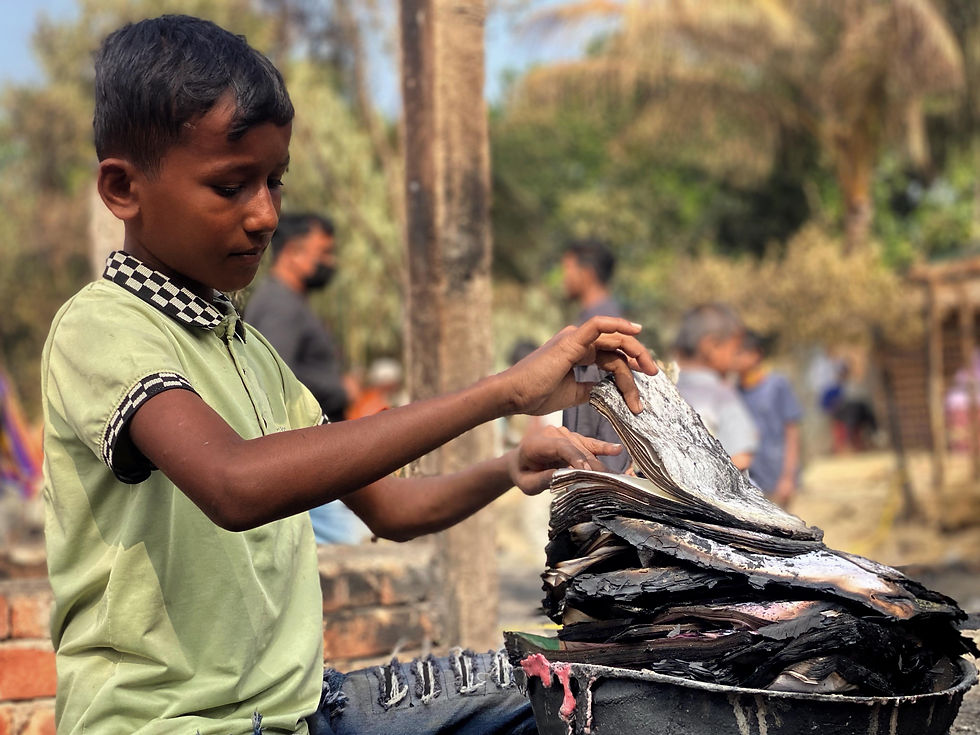
On December 28, 2025, at approximately 9:45 PM, the nightmare returned. For over an hour, flames tore through the block. Before the Bangladesh Fire Service arrived an hour later, Rohingya volunteers had already stepped up, risking their lives to bring the blaze under partial control. By the time the fire was fully extinguished, the damage was extensive: 40 shelters were reduced to ash, along with a learning center, a school, and a religious maktab.

While victims received immediate first aid and hot meals, the deeper recovery remains stalled. Despite the repetition of these fire incidents, there is still no long-term strategy to prevent them.
The scale of this crisis is underscored by alarming data from the Inter-Sector Coordinator Group (ISCG) . Between 2018 and 2024, the camps were destroyed by 1,800 recorded fire incidents—a staggering frequency that has claimed 33 lives and left over 1,000 people injured.

The root causes are well-documented, beginning with the widespread use of flammable materials. All Rohingya shelters are built from bamboo, tarpaulin, and plastic rope, materials that become tinder-dry and highly flammable during the dry season.
Because all Rohingya shelters are constructed from bamboo, tarpaulin, and plastic rope, they become tinder-dry during the heat of the dry season. This turns densely packed blocks, where population density can exceed 95,000 people per square kilometer, into high-speed conduits for fire.
For those living through it, the terror is visceral. "I have a daughter with a disability; I feared the most for her," said 55-year-old Noor Jahan, who narrowly escaped.

"We managed to escape, but the days and nights since the fire have been far more challenging." Muhammad Siraj, 35, shared a similar fear for his daughter, who has a mental disability: "I thought I would lose her in the fire."

These tragedies become worse because of how the camps are built. Fire trucks often cannot reach the main fire because the paths are too narrow. Amir Hossain, a 70-year-old grandfather caring for nine family members, stood waiting for help after losing everything in the fire.
"Every time there is a fire, it is hard to save our kids and family from this crowded camp, let alone our belongings," Amir said. He expressed a common frustration with the slow pace of recovery: "We have to wait nearly one month to get a new shelter, and it is bamboo again."

This cycle of "burn and rebuild" has led to growing cynicism. Some victims believe the continued use of vulnerable materials is a way for organizations to maintain a state of emergency to secure funding. Meanwhile, the use of LPG cylinders in cramped, combustible kitchens remains a lethal necessity; investigators note that a majority of the 1,800 fires originate from these cooking fuels.
"The fire took everything from us," said 26-year-old Hamida Begum, sitting by a damaged wall. "Almost every year, we face such incidents in the refugee camps. Once it starts, it doesn’t stop until the entire block is burnt."

At the heart of the issue is a policy of enforced transience. The government restricts permanent construction, fearing that durable housing would encourage long-term settlement. Consequently, safer materials like brick, concrete, or corrugated iron remain prohibited, even eight years into the displacement.

Humanitarian agencies have repeatedly warned that this risk is not accidental, but a direct consequence of "temporary" housing policies. While authorities recently approved ‘Temporary Safer Shelters’ made with treated bamboo and fire-resistant tarpaulin, a massive funding gap with the response only 50% to 75% funded, means most remain unprotected.
The toll is not just physical, but psychological. Fires occurring at night have triggered a wave of insomnia and chronic anxiety.
Shofika, 40, sat on the burnt floor of her shelter, her voice reflecting the exhaustion of a community in a state of permanent alert: "I fear fire because it keeps happening again and again."

Until authorities move beyond a "temporary" mindset and allow for innovative, durable construction, the Rohingya will remain trapped in a cycle of ash and rebuilding, waiting for a spark that they know is coming

References
UNHCR. Rohingya refugees lead response to fire threat in Bangladesh camps.
UNICEF. More than 60 Rohingya babies born in Bangladesh refugee camps every day.
World Health Organization. Cox’s Bazar Monthly Health Sector Situation Reports (2024–2025).
Save the Children. Massive fire devastates Rohingya refugee camps in Cox’s Bazar.
ReliefWeb. Fire incidents and humanitarian response in Rohingya refugee camps.


