


Enayet Khan and the Rohingya Art Movement: Drawing Memory, Training a Future

By Ahtaram Shin

Enayet Khan is a 27-year-old Rohingya visual artist raised in Nwa Yong Thong village, Arakan. Today, he is one of the key figures shaping a new Rohingya art movement rooted not in spectacle, but in continuity, preserving cultural memory while training a generation born into displacement.
Forced to flee Myanmar in 2017, Enayet arrived in Bangladesh with almost nothing. What he carried with him was less visible: memory, observation, and a way of seeing shaped by village life.
“I lost my home,” he says, “but I did not lose my stories.” Art became the means through which those stories survived.
From an early age, Enayet sketched the natural world around him: farming scenes, rivers, tools, clothing, festivals.
Drawing was not a hobby but a language. “If I want to explain anything,” he says, “the best language I can use is art.”
That language would later become essential in the refugee camps, where words often failed to contain the scale of loss.

After the exodus, Enayet continued to paint daily life in displacement alongside memories of Arakan. His work documents Rohingya culture with careful accuracy, from fishing practices to rural architecture, resisting the reduction of his people to anonymous victims. Because of this precision, his artworks are now widely used by NGOs in education, training, and health programmes inside the camps.

One of his most striking works, The Flood of Blubbering, depicts a man overwhelmed by grief amid fleeing families and burning villages. It is not illustrative; it is forensic. The painting has become a visual reference for understanding the Rohingya genocide beyond numbers and headlines.
Alongside his individual practice, Enayet works collectively. He collaborated on large-scale murals with Artolution and has participated in exhibitions that brought Rohingya narratives to audiences outside the camps, including Renaissance of Rohingya Culture at the Dhaka Literary Festival (2023), Picturing the Rohingya Genocide at the Rohingya Centre of Canada (2023), and The Rohingya Experience in Jersey (2024).

In 2023, Enayet founded the Rohingya Art Club (RAC), not as an art school, but as a community structure. Starting with a small group of adolescents, the club now has 50 active members, including 15 highly skilled artists. Through weekly classes across multiple camps, RAC has trained more than 500 adolescents.
The club focuses on three areas:
Technical training, introducing drawing, sketching, colour theory, and visual storytelling grounded in Rohingya cultural references.
Artist development, where mentors themselves are trained to expand styles and methods, strengthening internal leadership rather than dependency.
Live art sessions, public drawing events that invite children and adults to participate. These sessions function as informal therapy — moments of shared attention and relief in an otherwise restricted environment.

Enayet is also an art director and mentor for Rohingyatographer, supporting young artists to tell their own stories rather than perform narratives expected by outsiders. Through the collective, Rohingya youth document and publish their own memories, building an archive authored from within the community.

Life in overcrowded camps has created a dangerous rupture. Children born there have never seen traditional Rohingya farming, fishing, or festivals. Without lived reference, identity erodes quietly. Art fills this gap. Through drawing and model-making, children learn how their grandparents lived, worked, and celebrated. Each image becomes both record and transmission.
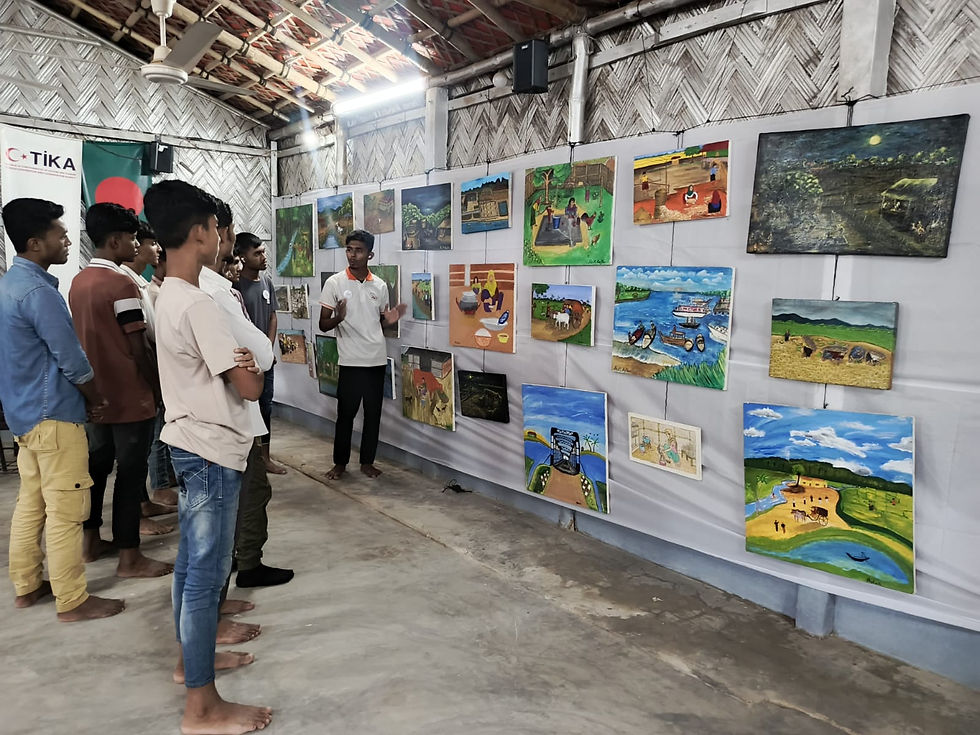
The Rohingya Art Club has organised exhibitions such as Past Remembrance and Future Hope at Allegro Art Café, The Colours of Displacement and Determination with Tika Centre, and My Homeland with the Rohingya Youth Initiative. The club also runs cultural programmes using miniature models of traditional homes and tools, allowing children to touch and recognise their heritage. Recently, RAC organised an art competition celebrating emerging talent across the camps.

Challenges remain constant. Art materials are scarce. Teaching spaces are limited. Funding is inconsistent. Many students balance training with daily labour to support their families. Yet the work continues. “Art is not decoration,” Enayet says. “For us, it is survival.”
For Enayet Khan and the Rohingya Art Club, art is not an escape from reality. It is a method of holding it in place, memory against erasure, skill against stagnation, continuity against disappearance. In a landscape defined by loss, each drawing becomes an act of persistence.
Follow Enayet’s work


